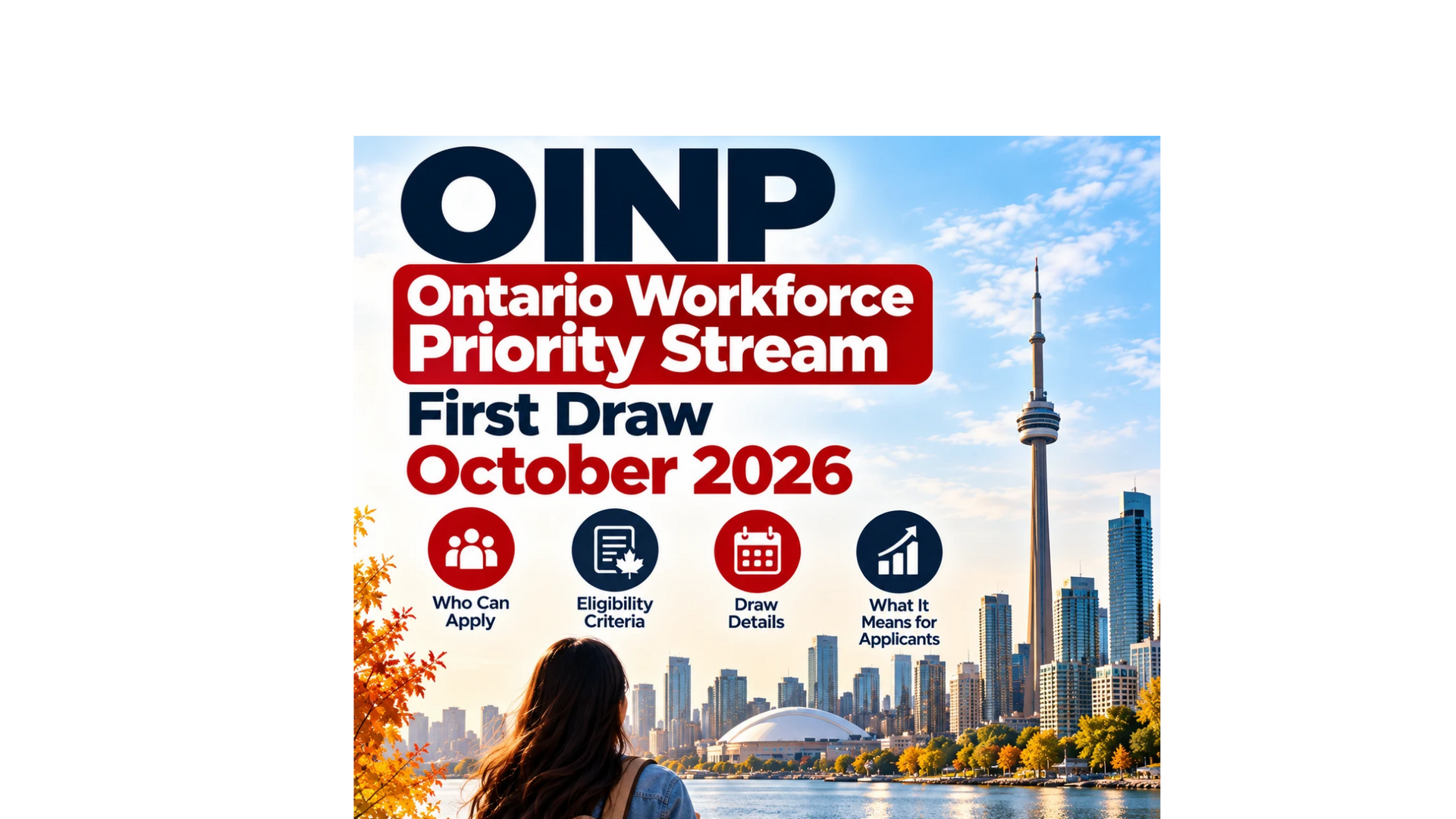
Ontario Workforce Priority Stream 2026: Full Eligibility Guide
On July 20, 2026, Ontario published the complete eligibility requirements for the new Ontario Workforce Priority Stream on its official ontario.ca website. This is the most significant development in Ontario's provincial immigration program since the province eliminated all eight of its former streams on June 26, 2026, and it is the update that workers, graduates, and employers across the province have been waiting for.
The Ontario Workforce Priority Stream is the replacement for every previous Ontario Immigrant Nominee Program pathway. It covers skilled workers in all NOC TEER categories through two primary pathways, and includes a third pathway for self-employed physicians who do not need a job offer at all. Ontario has also confirmed that the Expression of Interest system has not yet reopened and is anticipated to launch later in the summer of 2026, meaning right now is the time to understand the requirements and confirm your eligibility before the portal opens.
This blog covers everything confirmed in the official ontario.ca publication of July 20, 2026, including work experience, language, and education requirements, employer eligibility, the scoring factors that will determine who gets invited, and what this means specifically for workers and employers in Northern Ontario.
Not sure if you qualify under the new Ontario Workforce Priority Stream? Book a consultation with iCA Immigration and Talent Services today and get clarity from a licensed RCIC. https://www.ica-immigration.ca/book-a-consultation
What Is the Ontario Workforce Priority Stream?
The Ontario Workforce Priority Stream is Phase 1 of Ontario's redesigned provincial nomination program. It was introduced through amendments to Ontario Regulation 422/17 under the Ontario Immigration Act, 2015, which came into force on June 25, 2026, with the full eligibility criteria published on the official ontario.ca website on July 20, 2026.
The stream offers eligible skilled foreign workers with a qualifying job offer and work experience in any National Occupational Classification occupation a pathway to apply to permanently live and work in Ontario. The stream is also available to eligible self-employed physicians who do not have a job offer.
What Happened to the Old OINP Streams?
All eight former OINP streams were removed as of June 26, 2026. The streams that were eliminated include the Employer Job Offer Foreign Worker stream, the Employer Job Offer In-Demand Skills stream, the Employer Job Offer International Student stream, the Masters Graduate stream, the PhD Graduate stream, the Express Entry Human Capital Priorities stream, the Express Entry French-Speaking Skilled Worker stream, and the Express Entry Skilled Trades stream.
The Expression of Interest system is now closed to new expressions of interest under the former streams. No further invitations will be issued under any former stream. Applications submitted following an invitation under a former stream will continue to be assessed against the eligibility requirements that were in place at the time of submission.
When Can You Actually Apply?
You cannot apply today. The Expression of Interest system for the Ontario Workforce Priority Stream is anticipated to open later in the summer of 2026. When the system opens, your employer must initiate the process by submitting a job offer in the Employer Portal. You then have 30 calendar days from your employer's submission to register your expression of interest.
Employers who previously registered in the Employer Portal do not need to re-register. They will need to submit a new job offer and a new application for approval of an employment position to initiate a new expression of interest under the new stream.
Who Qualifies: Full Eligibility Requirements
To qualify for nomination under the Ontario Workforce Priority Stream with a job offer, you must meet all of the following requirements. There are different thresholds depending on the TEER category of your job offer NOC code. The TEER category is determined by the second digit of the 5-digit NOC code for your occupation.
Work Experience Requirements
TEER 0-3 Work Experience
If your job offer is in a TEER 0, 1, 2, or 3 occupation, you must meet one of the following four work experience options.
Option 1: Six months consecutive with your job offer employer. You must have at least 6 months of consecutive, paid, full-time work experience in the exact employment position your employer is seeking approval for, within the 12 months before you submit your application. Full-time means the same occupation, employer and location, requiring at least 390 hours of paid work in a 12-month period at a minimum of 30 hours per week.
Option 2: Three months for recent Ontario graduates. If you graduated from an eligible Ontario institution within the last 3 years with a post-secondary degree or diploma taking at least 2 years to complete, an Ontario College Graduate Certificate, a Master's degree, or a PhD, you only need 3 months of consecutive paid full-time experience with your job offer employer within the last 12 months.
Option 3: Two years cumulative in the same NOC occupation. You must have at least 2 years of cumulative paid full-time work experience within the 5 years before your application, totalling at least 3,120 hours at 30 hours per week over a 2-year period. Part-time equivalent experience is accepted. The experience does not have to be with your job offer employer. This is the most flexible option.
However, there are three specific situations where experience in a related occupation counts toward this option:
Experience as a professional engineer in Sub-Major Group 213 counts toward a job offer as an engineering technician in Sub-Major Group 223. Experience as a pharmacist in NOC 31120 counts toward a job offer as a pharmacy technical assistant in NOC 33103. Experience as a licensed practical nurse in NOC 32101 or as a registered nurse in NOC 31301 counts toward a job offer as a nurse aide or orderly in NOC 33102.
Option 4: Mandatory licence or authorization. If your employment position legally requires a licence or other authorization under Ontario or Canadian law to perform the work, holding that valid licence exempts you from the work experience requirement entirely. This applies whether you are inside or outside Canada.
Important exception for transport workers: NOC 73300 transport truck drivers and NOC 73301 bus drivers must still meet the 6-month consecutive experience requirement, even if they hold a mandatory licence or are recent Ontario graduates.
TEER 4-5 Work Experience
If your job offer is in a TEER 4 or 5 occupation, the requirement is different and stricter. You must have at least 9 months of cumulative paid full-time work experience in the exact employment position your employer is seeking approval for, gained within 2 years before your application. Full-time means at least 1,170 hours per 12-month period at 30 hours per week.
Critically, all 9 months must be with the specific employer who is making your job offer. There is no alternative occupational route and no graduate reduction for this pathway.
Language Requirements
TEER 0-3 Language
If your job offer is in a TEER 0, 1, 2, or 3 occupation, you must meet one of the following:
CLB 6 or higher in all four language proficiencies, for any occupation that is not a listed skilled trade. CLB 5 or higher in all four language proficiencies, if your job offer is in a listed skilled trade. No language test required, if you graduated from an eligible Ontario institution within the last 3 years with a qualifying credential.
Your language test must have been taken within 2 years before your application submission date.
What Counts as a Skilled Trade for Language Purposes
The following NOC major groups qualify as listed skilled trades occupations for the CLB 5 language threshold: Major Group 72 (Technical trades and transportation), Major Group 73 (General trades), Major Group 82 (Supervisors in natural resources, agriculture and related production), Major Group 83 (Occupations in natural resources and related production), and Major Group 93 (Central control and process operators, excluding Sub-Major Group 932 aircraft assemblers). Minor Group 6320 (Cooks, butchers, bakers) and Unit Group 62200 (Chefs) also qualify.
TEER 4-5 Language
If your job offer is in a TEER 4 or 5 occupation, you need CLB 4 or higher in all four language proficiencies.
Accepted Language Tests
For English, the accepted tests are IELTS General Training only (not Academic or One Skill Retake), CELPIP General only, and PTE Core only. For French, the accepted tests are TEF Canada and TCF Canada.
Education Requirements
TEER 0-3 Education
If your job offer is in a TEER 0, 1, 2, or 3 occupation, you must have one of the following:
A post-secondary degree or diploma of at least one year full-time from an eligible Canadian institution or its foreign equivalent supported by an Educational Credential Assessment, if your job offer is not in a listed skilled trade. A Canadian secondary school diploma or its foreign equivalent, if your job offer is in a listed skilled trade. An Ontario college certificate of at least one year full-time specifically for those applying for a NOC 33102 nurse aide or orderly position. A mandatory licence or authorization for the position, as an alternative to an education credential, except for transport truck drivers and bus drivers.
Foreign credentials require an Educational Credential Assessment report from one of the designated organizations. The report must be less than 5 years old at the time of application.
TEER 4-5 Education
If your job offer is in a TEER 4 or 5 occupation, you need a Canadian secondary school diploma or its foreign equivalent.
Every immigration case is unique. Before making any decisions, speak with Jennifer Johnson, RCIC at iCA Immigration and Talent Services to review how these requirements apply to your specific situation. https://www.ica-immigration.ca/book-a-consultation
How the Application Process Works
Once the Expression of Interest system opens later in summer 2026, the process follows these steps.
Step 1: Your employer submits a job offer through the Employer Portal. Your employer must initiate the process. Without their submission, you cannot register an expression of interest.
Step 2: You register your expression of interest within 30 calendar days of your employer's job offer submission.
Step 3: If invited to apply for OINP, your employer confirms the job offer within 14 calendar days on the employer portal. You must submit your application and pay within 17 calendar days of the invitation, and only after your employer has submitted their application first.
Once Ontario approves your nomination, you must apply to IRCC for permanent residence within 6 months.
The Express Entry Connection
If your job offer is in a TEER 0, 1, 2, or 3 occupation, you may choose to register your Ontario nomination through the Express Entry system. This adds 600 CRS points to your profile, which nearly guarantees an Invitation to Apply from IRCC in the next Express Entry round that you qualify for. You then have 30 days to accept the nomination and 60 days to submit your permanent residence application to IRCC.
Scoring Factors That Determine Invitations
Your expression of interest will receive points based on the following factors. Understanding the scoring helps you assess your competitiveness before the portal opens.
NOC category earns up to 9 points with TEER 0 or 1 scoring highest. Hourly wage earns up to 15 points with $40 or more per hour scoring the maximum. Ontario work experience earns up to 18 points with more than 24 months in the job offer position scoring the highest. Education level earns up to 10 points with a doctorate or professional degree scoring highest. Language ability earns up to 15 points with CLB 9 or higher scoring the maximum. Regional location earns up to 15 points with Northern Ontario scoring the maximum.
What This Means for Workers and Employers in Northern Ontario
The Ontario Workforce Priority Stream includes specific advantages for Northern Ontario that are worth understanding clearly.
Northern Ontario earns the highest regional scoring points. The location of your job offer in the scoring system awards 15 points for Northern Ontario, the highest regional score in the entire system. Toronto earns 0 regional points. For workers and employers in Sault Ste. Marie, Sudbury, Thunder Bay, Timmins, and other Northern Ontario communities, this regional advantage can be significant in a competitive expression of interest pool.
Sault Ste. Marie is located in Algoma District, which is explicitly listed as part of Northern Ontario in the scoring system. Both Sault College and Algoma University are on the list of eligible Ontario institutions, meaning local graduates may qualify for the reduced 3-month work experience option.
Lower employer revenue thresholds apply outside major census metropolitan areas. The official ontario.ca page confirms that lower gross annual revenue requirements apply to employers in rural communities, defined as communities located in a census division with a population of less than 150,000. Most Northern Ontario communities meet this threshold.
The related occupation exception directly benefits Northern Ontario sectors. The healthcare and engineering sectors are among the most common in Northern Ontario. The exception allowing nursing experience to count toward a PSW job offer, pharmacist experience to count toward a pharmacy assistant job, and engineering experience toward an engineering technician job offer, expands eligibility for workers in exactly these fields.
The licence exemption is directly relevant to trades workers. Northern Ontario has a significant skilled trades workforce. Workers who hold a mandatory provincial or federal licence for their occupation are exempt from the work experience requirement entirely, whether they are in Canada or outside it.
Common Mistakes to Avoid
Assuming the six-month experience option is the only route for TEER 0-3. Many candidates focus only on the six-month consecutive option with their current employer and assume they do not qualify if they have not been in that specific role for six months. The two-year cumulative NOC occupation option, and the related occupation exception for nurses, engineers, and pharmacists, provide alternative routes that many eligible candidates overlook entirely.
Confusing cumulative and consecutive experience. The six-month and three-month options require consecutive experience with the same employer. The two-year option allows cumulative experience with breaks in employment allowed. The nine-month TEER 4-5 option is cumulative but must still be with the same employer. Applying the wrong type of experience to the wrong option is one of the most common errors in OINP applications.
Not confirming the mandatory licence exemption before applying. Candidates who hold a mandatory provincial or federal licence for their occupation may qualify without any Canadian work experience at all. However, there is an important exception: transport truck drivers and bus drivers must still meet the six-month consecutive experience requirement even if licensed. Assuming the exemption applies to every licensed occupation is incorrect.
Not checking your NOC code before the EOI system opens. Your TEER category is determined by the second digit of your five-digit NOC code. Getting this wrong affects every aspect of your eligibility assessment including work experience, language, education, and scoring. Confirm your NOC code with a licensed RCIC before the portal opens.
Waiting for the EOI system to open before reviewing employer eligibility. If your employer does not qualify, the process cannot begin regardless of your own eligibility. Employers must have been in active business for at least 3 years, have a qualifying Ontario business premises, meet the revenue and employee headcount thresholds, and have no outstanding orders under Ontario labour regulations. Reviewing employer eligibility before the portal opens avoids discovering a disqualifying issue at the last moment.
Ready to Take the Next Step?
Canada's immigration rules change frequently and deadlines can be unforgiving. The Expression of Interest system for the Ontario Workforce Priority Stream is anticipated to open later this summer. Candidates who have confirmed their eligibility, verified their employer's qualifications, and reviewed their scoring profile before the portal opens will be in the strongest position to submit the moment invitations begin.
Jennifer Johnson is a Regulated Canadian Immigration Consultant (RCIC #R709916) based in Sault Ste. Marie, Ontario, serving clients across Northern Ontario and beyond.
Book your consultation today: https://www.ica-immigration.ca/book-a-consultation
Frequently Asked Questions
Q: What is the Ontario Workforce Priority Stream and when were the eligibility requirements published? A: The Ontario Workforce Priority Stream is the new provincial nomination pathway that replaced all eight former OINP streams, which were eliminated on June 26, 2026. The complete eligibility requirements were published on the official ontario.ca website on July 20, 2026. The stream covers skilled workers with a job offer in any TEER 0 through 5 occupation, as well as self-employed physicians who do not need a job offer. The Expression of Interest system is anticipated to open later in summer 2026. Contact iCA Immigration and Talent Services to review your eligibility before the portal opens.
Q: How many months of work experience do I need for the Ontario Workforce Priority Stream? A: It depends on your job offer TEER category and which work experience option you use. For TEER 0-3 occupations, the options are 6 months consecutive with your job offer employer in the last 12 months, 3 months consecutive for recent Ontario graduates, 2 years cumulative in the same NOC occupation in the last 5 years, or a mandatory licence for the position. For TEER 4-5 occupations, you need 9 months cumulative with the same employer making the job offer within the last 2 years. Contact iCA Immigration and Talent Services to determine which option applies to your situation.
Q: Can my experience as a nurse, pharmacist or engineer count toward a different job offer under the new OINP stream? A: Yes, in specific situations. The Ontario Workforce Priority Stream includes a related occupation exception confirmed in the official ontario.ca regulation. Experience as a registered nurse or licensed practical nurse counts toward a job offer as a nurse aide or orderly in NOC 33102. Experience as a pharmacist in NOC 31120 counts toward a job offer as a pharmacy technical assistant in NOC 33103. Experience in professional engineering occupations in Sub-Major Group 213 counts toward a job offer as an engineering technician in Sub-Major Group 223. Book a consultation with iCA Immigration and Talent Services to confirm whether this exception applies to your specific NOC codes.
Q: Do I need a Canadian licence to be exempt from the work experience requirement? A: The exemption applies to any mandatory licence or other authorization required under Ontario or Canadian law to perform the work in the job offer employment position. This can include provincial licences or federally regulated authorizations such as a Transport Canada Aircraft Mechanic licence. If your occupation legally requires a licence, and you hold a valid licence from the appropriate regulatory body in Ontario or Canada, you may qualify without work experience in Canada. The exemption does not apply to NOC 73300 transport truck drivers and NOC 73301 bus drivers, who must still meet the 6-month consecutive experience requirement. Contact iCA Immigration and Talent Services to confirm whether your licence qualifies.
Q: What advantage does Sault Ste. Marie offer under the new OINP scoring system? A: Sault Ste. Marie is in Algoma District, which is explicitly listed as part of Northern Ontario in the Ontario Workforce Priority Stream scoring system. Northern Ontario is awarded 15 EOI scoring points for regional location, the highest score of any region in Ontario. Toronto earns 0 regional points for comparison. This means a candidate with a job offer in Sault Ste. Marie automatically receives 15 scoring points that would not be available to the same candidate with a job offer in Toronto. Sault College and Algoma University are also on the list of eligible Ontario institutions, meaning recent local graduates may qualify for the reduced 3-month work experience option. Book a consultation with iCA Immigration and Talent Services to understand your full scoring profile under the new stream.
References
All information in this blog has been verified against official Ontario and Canadian government sources as of July 20, 2026.
- Government of Ontario, Ontario Workforce Priority Stream (published July 20, 2026) https://www.ontario.ca/page/ontario-workforce-priority-stream
- Government of Ontario, 2026 Ontario Immigrant Nominee Program Updates (July 20, 2026 update) https://www.ontario.ca/page/2026-ontario-immigrant-nominee-program-updates
- Ontario Regulation 422/17 under the Ontario Immigration Act, 2015 (as amended June 25, 2026) https://www.ontario.ca/laws/regulation/170422
- Government of Canada, Provincial Nominee Program https://www.canada.ca/en/immigration-refugees-citizenship/services/immigrate-canada/provincial-nominees.html
Note: Immigration policies change frequently. While every effort has been made to ensure accuracy, we recommend verifying current requirements at ontario.ca or booking a consultation with a licensed RCIC before making any immigration decisions.